Pharma's Playbook: How Auchincloss Adopted Big Drug's Talking Points on Pharmacy Benefit Manager Reform
December 26, 2025
In December 2025, Rep. Jake Auchincloss introduced the “Pharmacists Fight Back Act,” which he promoted as “the most comprehensive PBM [pharmacy benefit manager] reform in federal health plans introduced this Congress.”1 The bill targets pharmacy benefit managers, the companies that negotiate drug prices between manufacturers, insurers, and pharmacies. In announcing the legislation, Auchincloss described PBMs as “the middlemen of drug pricing” who are “driving up drug costs by thousands of dollars, gouging community pharmacists, and limiting patient choice.”1
If that language sounds familiar, it should. It is nearly identical to the messaging that the pharmaceutical industry has spent tens of millions of dollars promoting through advertising campaigns, lobbying efforts, and astroturf coalitions. The Pharmaceutical Research and Manufacturers of America, known as PhRMA, has built an entire public relations strategy around blaming PBMs for high drug prices, and Auchincloss’s rhetoric follows their playbook almost word for word.
The Shared Vocabulary of Blame
The alignment between Auchincloss’s messaging and pharmaceutical industry talking points is not subtle. Both use the same emotionally charged buzzwords to describe PBMs and frame the policy debate.
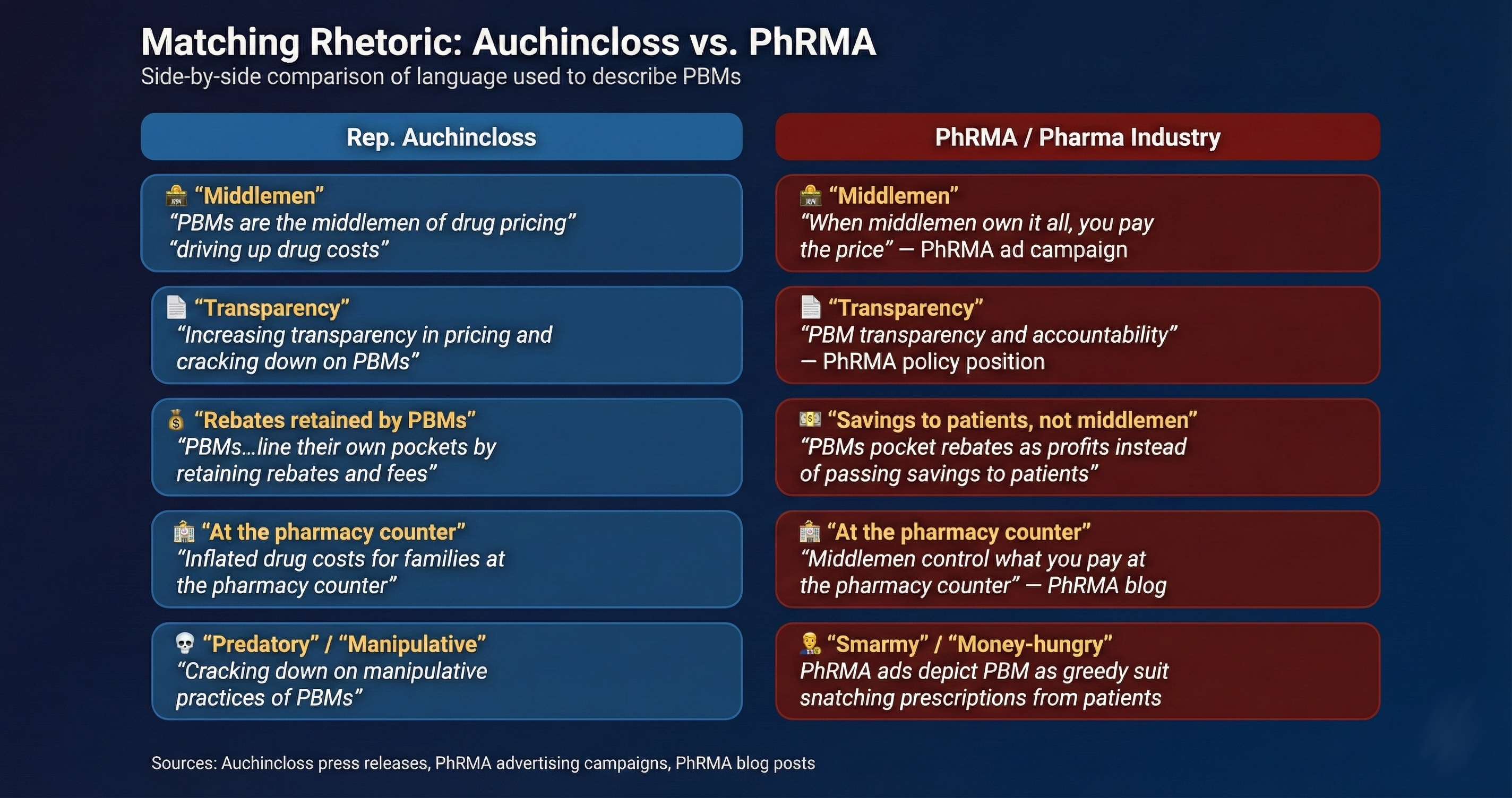
Auchincloss’s press release announcing the Pharmacists Fight Back Act states that “Patients, community pharmacies, and taxpayers have been forced to shoulder the burden of rising drug prices at the hands of PBMs.”1 Compare this to PhRMA’s advertising campaign, which warns that “When middlemen own it all, you pay the price” and depicts a greedy PBM executive gleefully snatching prescriptions from patients.2 The framing is identical: PBMs are portrayed as the villains responsible for Americans’ high prescription costs, not the pharmaceutical companies that actually set drug prices.
PhRMA’s Deliberate Strategy
The pharmaceutical industry’s focus on PBMs is not organic. It is a calculated public relations strategy designed to deflect attention from manufacturers’ role in setting high drug prices. Facing public anger over the cost of prescription medications, PhRMA and its member companies have spent years cultivating a narrative that positions PBMs as the “middlemen” who are really to blame.
PhRMA has publicly supported PBM transparency legislation, arguing that reforms should ensure “PBMs share negotiated savings with patients at the pharmacy counter and are no longer compensated off the list price of a medicine.”3 This language is almost indistinguishable from Auchincloss’s own statements about his bill. His 2023 remarks celebrating the House passage of a PBM transparency measure declared that “Increasing transparency in pricing and cracking down on PBMs will put money back where it belongs – into the pockets of patients dependent on life-saving medication.”4
The shared emphasis on “transparency” and “pass-through pricing” serves a particular function: it frames the problem of high drug costs as one of distribution rather than production. If the issue is that PBMs are pocketing rebates instead of passing them to patients, then the solution is PBM reform. But if the issue is that drug manufacturers are setting exorbitant prices in the first place, then the solution requires taking on pharmaceutical companies directly through measures like Medicare price negotiation, which PhRMA has fiercely opposed.
The ATAP Coalition: Patient Advocates or Industry Allies?
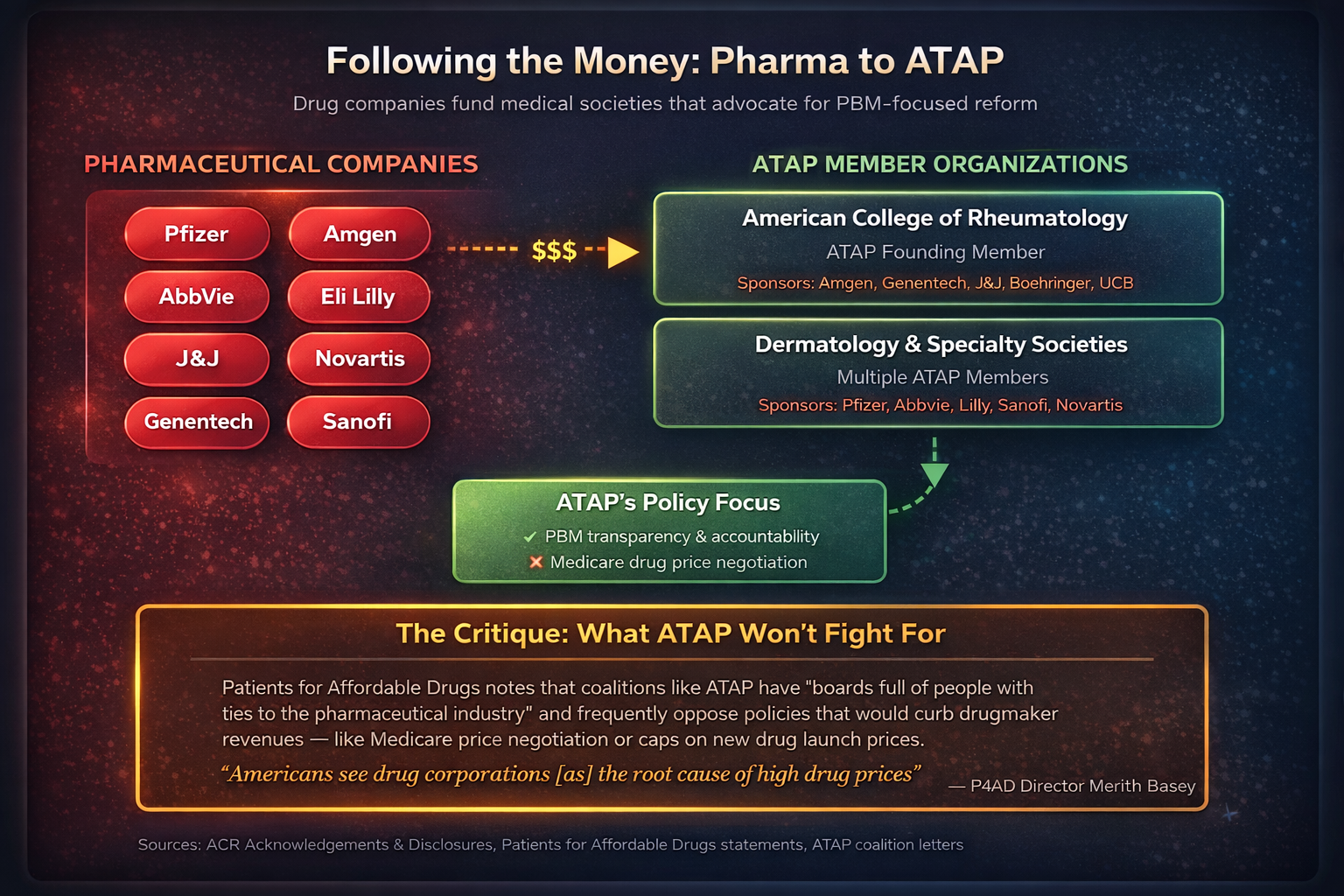
Auchincloss’s PBM legislation has been supported by the Alliance for Transparent and Affordable Prescriptions, known as ATAP, a coalition that presents itself as representing patients and healthcare providers.5 ATAP has signed letters urging Congress to enact “transparency, accountability, and fairness” in the PBM system, using much of the same language that appears in Auchincloss’s talking points.5
However, critics argue that ATAP functions more as a vehicle for pharmaceutical industry interests than as a genuine patient advocacy organization. Patients for Affordable Drugs, a group that takes no pharmaceutical industry funding, has pointed out that ATAP’s member organizations receive substantial financial support from drug manufacturers.6
The American College of Rheumatology, a founding member of ATAP, lists Amgen, Genentech, Boehringer Ingelheim, Johnson & Johnson, and UCB among its 2025 corporate sponsors.7 Other ATAP member organizations count Pfizer, AbbVie, Eli Lilly, Sanofi, Regeneron, and Novartis among their major financial partners. These are the same companies whose drug pricing practices would face scrutiny under policies that ATAP has notably declined to support, such as Medicare price negotiation or caps on new drug launch prices.
Patients for Affordable Drugs’ director Merith Basey has emphasized that Americans understand “drug corporations [as] the root cause of high drug prices.”6 The organization argues that ATAP’s singular focus on PBMs amounts to a “blame game” that serves pharmaceutical interests by “shifting public attention” away from manufacturers’ pricing power.
What Auchincloss Does Not Say
The most telling aspect of Auchincloss’s PBM messaging is what he leaves out. His press releases, interviews, and bill promotions focus entirely on PBM practices like spread pricing, rebate retention, and pharmacy steering. They do not address the fundamental question of why drug prices are so high in the first place.
Pharmaceutical companies in the United States have sole discretion to set and raise the prices of their products. A drug that costs $10 to manufacture can be priced at $10,000 if the manufacturer chooses. No amount of PBM reform changes this basic fact. Even if every rebate were passed through to patients and every PBM operated with complete transparency, drug manufacturers could simply raise their list prices to compensate.
The pharmaceutical industry understands this, which is why they have invested so heavily in promoting the narrative that PBMs are the real problem. As one industry observer noted in an op-ed highlighted by the PBM industry trade group, “Drug manufacturers are attempting to distract from their sole discretion to set and raise prescription drug prices by blaming PBMs… Big Pharma invented a new boogeyman: PBMs – and perpetuated myths that other special interests now repeat.”8
Auchincloss’s rhetoric serves this exact function. By focusing exclusively on PBM practices and using language that could come directly from a PhRMA press release, he reinforces the pharmaceutical industry’s preferred framing of the drug pricing debate. This is not to say that PBM practices do not merit scrutiny, as many patient advocates and independent pharmacists have legitimate concerns about PBM behavior. But when a member of Congress adopts the pharmaceutical industry’s talking points verbatim while ignoring manufacturers’ role in setting prices, it raises serious questions about whose interests he is actually serving.
The Bigger Picture: Deflection as Strategy
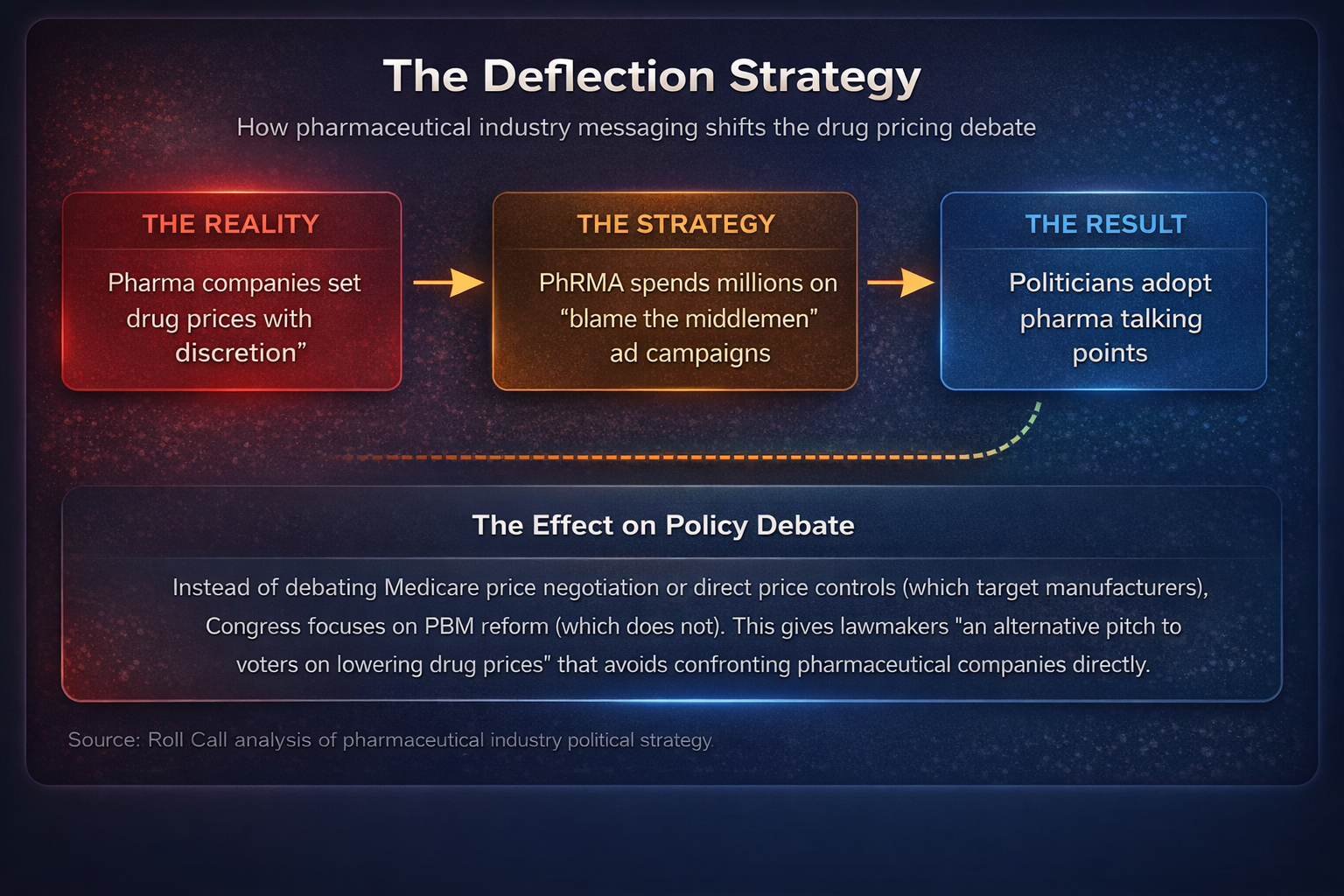
Political analysts have observed that the pharmaceutical industry’s anti-PBM campaign gained traction because it offers lawmakers “an alternative pitch to voters on lowering drug prices” that does not require confronting drug manufacturers directly.9 Instead of debating direct price controls or Medicare negotiation, which would cut into pharmaceutical profits, politicians can talk about PBM reform as a politically safer alternative.
This dynamic is particularly relevant for a Democrat like Auchincloss. While he has expressed support for some measures targeting drug manufacturers, his spotlight on PBM reform provides a bipartisan-friendly, industry-aligned talking point. Going after “middlemen” is easier than taking on pharmaceutical companies with their massive lobbying budgets and campaign contribution networks.
The evidence suggests that Auchincloss has made a choice about where to direct his rhetorical fire. He has chosen to aim at PBMs using language developed by the pharmaceutical industry, rather than focusing on the companies that actually determine what Americans pay for their medications. Whether this reflects genuine policy conviction or strategic positioning, the effect is the same: the conversation about drug prices gets redirected away from the manufacturers who set them.
Conclusion
Rep. Jake Auchincloss’s public messaging on PBM reform strongly parallels the pharmaceutical industry’s rhetoric, employing the same buzzwords and blame framework. He highlights transparency, middlemen, rebate pass-through, and patient costs in a way that echoes PhRMA’s narrative. The talking points he uses to promote his PBM legislation are, in many cases, indistinguishable from pharmaceutical industry press releases and advertising campaigns.
This alignment serves pharmaceutical interests by focusing the drug pricing debate on distribution rather than production, on PBM practices rather than manufacturer pricing decisions. While PBM reform may have merit on its own terms, the question Massachusetts voters should ask is why their representative has chosen to adopt the pharmaceutical industry’s framing so completely. When a congressman sounds exactly like a drug company’s PR campaign, it is worth examining whose interests that rhetoric ultimately serves.
References
-
Auchincloss, J. “Reps. Auchincloss, Comer, and Harshbarger Introduce the Bipartisan Pharmacists Fight Back Act.” Press Release, December 11, 2025. Retrieved from https://auchincloss.house.gov/media/press-releases/reps-auchincloss-comer-and-harshbarger-introduce-bipartisan-pharmacists-fight-back-act ↩ ↩2 ↩3
-
PhRMA. “PhRMA slams insurers that ‘own it all’ in new ad.” FiercePharma, April 11, 2025. Retrieved from https://www.fiercepharma.com/marketing/phrma-calls-out-insurers-own-pbms-pharmacies-new-ad ↩
-
PhRMA. “PhRMA Statement on House PBM Transparency Bills.” 2023. Retrieved from https://phrma.org/resources/phrma-statement-on-house-pbm-transparency-bills ↩
-
Auchincloss, J. “RELEASE: House Passes Auchincloss-Led Legislation to Lower Prescription Drug Prices for Medicaid Patients.” Press Release, December 12, 2023. Retrieved from https://auchincloss.house.gov/media/press-releases/release-house-passes-auchincloss-led-legislation-to-lower-prescription-drug-prices-for-medicaid-patients ↩
-
ATAP Advocates. “ATAP Signs Coalition Letter Calling for PBM Transparency and Accountability.” November 14, 2025. Retrieved from https://atapadvocates.com/atap-news/2025/11/14/atap-joins-broad-coalition-letter-calling-for-pbm-transparency-and-accountability ↩ ↩2
-
Patients For Affordable Drugs Now. “STATEMENT: Patients For Affordable Drugs Now Responds To Trump Administration’s Most Favored Nation Letters To Drugmakers.” August 1, 2025. Retrieved from https://patientsforaffordabledrugsnow.org/2025/08/01/statement-patients-for-affordable-drugs-now-responds-to-trump-administrations-most-favored-nation-letters-to-drugmakers/ ↩ ↩2
-
American College of Rheumatology. “Acknowledgements & Disclosures.” Retrieved from https://rheumatology.org/acknowledgements-disclosures ↩
-
PCMA. “ICYMI: Labor Unions And Employers Rely On Pharmacy Benefits For Lower Health Care Costs.” June 25, 2024. Retrieved from https://www.pcmanet.org/pcma-blog/icymi-labor-unions-and-employers-rely-on-pharmacy-benefits-for-lower-health-care-costs/ ↩
-
Roll Call. “The inescapable ad campaign for a wonky drug policy debate.” November 17, 2023. Retrieved from https://rollcall.com/2023/11/17/the-inescapable-ad-campaign-for-a-wonky-drug-policy-debate/ ↩